The Yarbrough National Genealogical & Historical Association Inc.
- Family Symbols
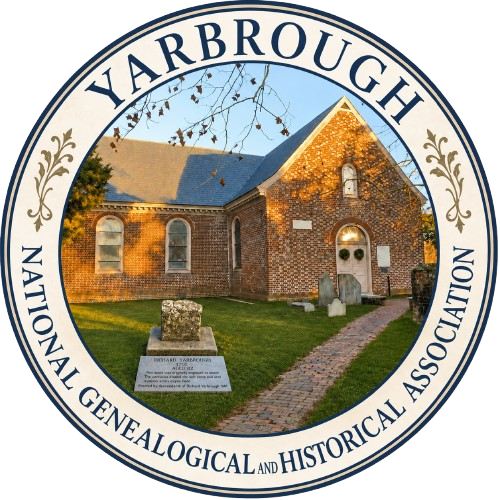
The logos of the Yarbrough National Genealogical and Historical Association pays homage to our earliest proven ancestor, Richard Yarbrough, who was born in England about 1615, emigrated to the Virginia colony around 1635 and died there in 1702. His resting place is at Old Blandford Church in Petersburg, Virginia. His grave is the oldest burial at Old Blandford and it is believed that the Church and cemetery are on lands he once owned and donated.
The original tombstone has weathered badly over the years, even though it still marks the location of his grave. During the 1980’s, the YNGHA commissioned a new tombstone that is pictured next to the old one in the photo. This tombstone will continue to honor the man believed to be the progenitor of American Yarbrough’s for centuries to come.
A Note and Caution About Yarbrough “Coats of Arms”
There are several Coats of Arms that have been awarded over the centuries to various branches of the English Yarbrough family. One was awarded to the Yarborough of Wilksby (Lincolnshire) and Yarborough of Heslington Hall (Yorkshire), with the latter tied to descendants of Eustachius de Yerburgh (Lord of Yarburgh around the Conquest era). The College of Arms has recorded several (nearly identical) versions for Lincolnshire and Yorkshire lines.
Since our Richard Yarbrough has not been conclusively proven back to his English roots, it is not yet possible for American Yarbrough’s to know if his line had a bonafide Coat of Arms. Coat of Arms in England were granted by royal authority (via the College of Arms) starting in the medieval period, primarily to individuals. They could be inherited by direct male-line descendants (with cadency marks for branches) and were used for identification in battle, tournaments, and seals.
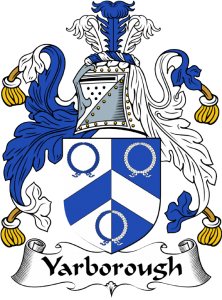
For these reasons the YNGHA has chosen to change its identification symbol from that illustrated below to the new designs shown at the top of this page.
The genealogical Best Practice is to research your specific lineage (e.g., via the College of Arms, Burke’s Peerage/Commoners) to confirm a connection to a branch containing a person entitled to heraldic arms. If none exists, you could petition for a new grant.
For deeper verification, consult resources like the College of Arms
(college-of-arms.gov.uk), Burke’s Peerage, or professional genealogists. Many Yarbrough lines share a common English origin, but Coat of Arms rights are individual/lineal.
For many in the Yarbrough family the “Coat of Arms” remains a deeply held historic symbol of the lineage, honor, courage, and family identity carried through generations of the Yarb(o)rough name. In recognition of that history and those that went before us proudly carrying that banner the following Historical Heraldry information is included.
- Historical Heraldry
A Symbol Of Family Legacy
The Yarb(o)rough Coat of Arms represents centuries of family history rooted in English heraldic tradition. Associated with Wilmsby, Lincolnshire, England, the heraldic record reflects the family’s historic standing and enduring ancestral identity.
While artistic renderings of the coat of arms may vary in style and presentation, the core heraldic elements have remained consistent throughout generations. These symbols continue to represent the values, heritage, and historical legacy connected to the Yarb(o)rough family name.
Heraldic Description
- Name: Yarb(o)rough
- Record : 18792
- Wilmsby, Lincolnshire, England
- Arms: Per pale argent and azure, a chevron between three chaplets all counterchanged.
- Crest: A falcon close or, belled gold, preying on a cock pheasant (or duck) proper.
- Motto: Non est sine pulvere palma. ("The prize is not won without dust.")
- Alternate Motto: Nocte Volamus. ("Who dares wins.")
- Meaning & Symbolism
Understanding The Coat Of Arms
Argent & Azure
The silver and blue colors symbolize loyalty, truth, wisdom, and integrity.
Chevron Shield
The chevron represents protection and faithful service, commonly used within traditional English heraldry.
Three Chaplets
The chaplets symbolize honor, achievement, and victory earned through perseverance.
Falcon Crest
The falcon reflects courage, vigilance, determination, and the noble spirit of the family lineage.
Belled Gold
The golden bells represent distinction, prestige, and recognition.
Pheasant Or Duck
The prey beneath the falcon symbolizes triumph, survival, and mastery through adversity.

- Family Tradition
Variations Of The Crest
Although heraldic rules follow established traditions, artistic interpretations of a coat of arms often vary between families, historians, and heraldic artists.
Despite these stylistic differences, nearly all Yarb(o)rough heraldic renditions preserve the same defining characteristics:
- Silver and blue heraldic colors
- Traditional shield featuring a central chevron
- Three counterchanged chaplets
- Falcon crest with golden bells
- Latin family motto
Some artistic renderings depict the bird in alternate positions, while others modernize the shield shape or decorative details. However, the essential heraldic identity remains consistent across generations.
- Family Motto
“Non Est Sine Pulvere Palma”
The traditional Yarb(o)rough family motto translates literally as:
“The prize is not won without dust.”
The phrase reflects perseverance, struggle, and the belief that honor and achievement are earned through effort and endurance.
The alternate family motto, “Nocte Volamus,” translates to:
“Who dares wins.”
Together, these mottos capture the courage, ambition, and resilience historically associated with the Yarb(o)rough family lineage.
- Historical Preservation
Heraldry Through Generations
Over centuries, members of the Yarb(o)rough family preserved their heraldic traditions through historical records, family documents, artwork, and genealogical research.
Modern renditions of the coat of arms continue to honor these traditions while adapting artistic styles for contemporary presentation. Whether displayed in manuscripts, engraved seals, family histories, or digital artwork, the heraldic symbols remain an enduring representation of ancestral heritage.
- Common Questions
Frequently Asked Questions
What is the meaning of the Yarb(o)rough Coat of Arms?
The coat of arms symbolizes heritage, perseverance, protection, courage, and family identity.
Where did the Yarb(o)rough heraldry originate?
The heraldic record is associated with Wilmsby, Lincolnshire, England.
What do the colors silver and blue represent?
In heraldry, silver symbolizes sincerity and peace, while blue represents loyalty and truth.
What does the falcon symbolize?
The falcon traditionally represents courage, vigilance, determination, and noble character.
What is the meaning of “Non est sine pulvere palma”?
The Latin motto translates to “The prize is not won without dust,” emphasizing effort and perseverance.
Why do some coat of arms designs look different?
What is a chevron in heraldry?
A chevron is a V-shaped symbol traditionally representing protection, faithful service, and accomplishment.
Are all Yarb(o)rough coats of arms identical?
No. Artistic styles may differ, but the main heraldic symbols and colors generally remain consistent.
What does the phrase “counterchanged” mean?
In heraldry, counterchanged means the colors of symbols are reversed across the shield design for balance and contrast.
Why is heraldry important in family history?
Heraldry helps preserve ancestral identity, historical lineage, and symbolic traditions passed down through generations.